.avif)

"I wanted to stop referencing the past and just ask: what does a beautiful watch look like today?"
Thomas Brissiaud is a Canadian designer and the founder of Tessé, an independent watch brand that assembles its watches in La Chaux-de-Fonds, Switzerland. His background is in design rather than traditional watchmaking, and his approach to creating watches reflects this: Tessé's references are conceived as design objects first, with the movement selection — exclusively Swiss Made — serving the aesthetic rather than driving it.
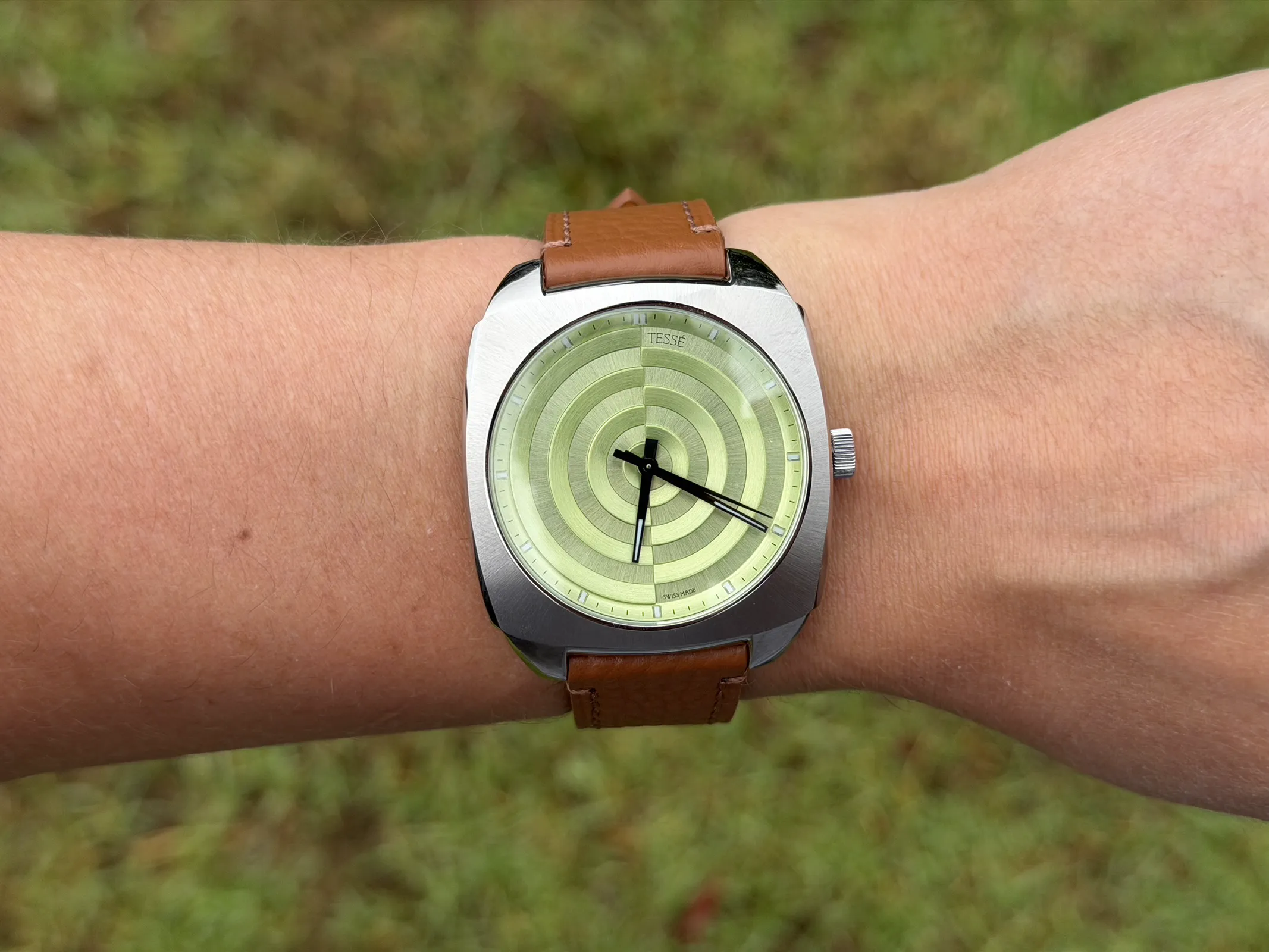
Brissiaud's engagement with watchmaking history is documented in his book The Forgotten Innovations of 70s Watchmaking, a research project that excavated the design and technical experiments of a decade that the industry had largely dismissed as the quartz crisis era. The Michel GMT, Tessé's first reference, drew directly from this research: a tonneau-cushion case with etched side surfaces, a 1970s-influenced colour palette, and a GMT function executed with characteristic restraint. The Architect, Tessé's second line, represents a deliberate departure from the same historical framework — a watch that asks what a beautiful contemporary timepiece looks like when it refuses to reference anything.
The Architect's dial, built from twenty-one individually machined and finished components with thirteen sculpted lume blocks, is one of the most considered dial constructions at its price point in independent watchmaking. Both Tessé lines launched via Kickstarter — used as a platform for visibility and direct collector connection rather than as a primary funding mechanism. Brissiaud's insistence on Swiss assembly, a 1200 HV anti-scratch case coating considerably harder than most tool steels, and a custom-engraved movement holder visible through the caseback reflects a finishing ambition that exceeds what most brands at Tessé's market position attempt.

.avif)